
What Happened to Arcimoto? Best FUV Alternatives in 2026
What Happened to Arcimoto? Best FUV Alternatives in 2026
If you have been searching for "what happened to Arcimoto" or looking for an Arcimoto alternative, you are not alone. The Oregon-based electric vehicle maker — once valued at over $1.2 billion — has experienced one of the most dramatic collapses in EV history. From a celebrated NASDAQ IPO to a market cap that collapsed to roughly $3,700, Arcimoto's story is a cautionary tale for anyone interested in lightweight electric vehicles.
But here is the good news: the idea behind Arcimoto was always sound. People want an affordable, efficient, weather-capable electric vehicle for daily commuting that does not cost $45,000 or require a two-car garage. The problem was never the concept — it was the execution, the regulatory classification, and the cash burn. In 2026, better alternatives exist. The Veemo SE and Veemo LT deliver on the original promise of the Arcimoto FUV — practical, affordable, enclosed electric commuting — without the baggage of motorcycle classification, insurance requirements, or a dying company's uncertain future.
In this guide, we cover the full Arcimoto story, why the FUV failed, and what the best Arcimoto FUV alternatives are in 2026.
The Rise and Fall of Arcimoto: A Complete Timeline
Understanding what happened to Arcimoto requires going back to the company's founding and tracing the trajectory from ambitious startup to near-total collapse.
The Vision (2007–2016)
Arcimoto was founded in 2007 in Eugene, Oregon by Mark Frohnmayer, son of former Oregon Attorney General Dave Frohnmayer. The founding thesis was compelling: most car trips involve a single occupant traveling short distances. A full-sized car is wildly over-engineered for this use case. What if you built an ultra-efficient vehicle purpose-designed for how people actually commute?
The company spent nearly a decade iterating on prototypes. The core concept evolved into the Fun Utility Vehicle, or FUV — a three-wheeled, tandem-seat, fully electric vehicle with a tilting canopy for weather protection. It looked like something from a sci-fi movie, and it captured the imagination of urban commuters, EV enthusiasts, and sustainable transportation advocates.
Through eight generations of prototypes, Arcimoto refined the design. The FUV was street-legal, highway-capable (with a top speed of 75 mph), and promised a range of about 100 miles on a single charge. At an anticipated price point around $12,000 for the base model, it seemed like a genuinely disruptive product.
The IPO and Hype Cycle (2017–2021)
Arcimoto went public on the NASDAQ in September 2017, raising capital to fund production of the FUV. The IPO generated significant media attention. Here was a small, mission-driven EV company with a genuinely different approach to personal transportation — not trying to build a better sedan, but rethinking the form factor entirely.
The stock price trajectory tells the story of what came next:
- 2017–2019: Modest trading as the company ramped production. FUV deliveries began in late 2019, initially to customers in Oregon.
- 2020: The pandemic-era EV hype cycle hit. Arcimoto's stock surged alongside every other EV company, regardless of fundamentals.
- 2021: Peak euphoria. Arcimoto's market cap briefly exceeded $1.2 billion. The stock traded above $30 per share. The company announced expansion plans, new models (the Deliverator for last-mile delivery, the Rapid Responder for emergency services), and a roadmap to mass production.
During this period, Arcimoto delivered roughly 400 vehicles. That means at peak valuation, each delivered vehicle was implicitly valued at approximately $3 million. The fundamentals never supported the stock price.

The Unraveling (2022–2024)
Reality set in quickly after the EV hype bubble deflated. Arcimoto faced a cascade of problems that ultimately proved fatal:
Scaling Failures
Arcimoto never figured out how to mass-produce the FUV at an affordable price. The original promise was a $12,000 vehicle. In practice, the FUV sold for $17,900 to $24,000 depending on configuration. Even at those prices, margins were likely negative. The company burned through cash at an alarming rate while producing only a trickle of vehicles — roughly 100 to 200 per year at peak.
Regulatory Classification as a Motorcycle
This was perhaps the single biggest commercial headwind. Because the FUV had three wheels, it was classified as an autocycle or motorcycle in most US states. This classification had devastating consequences for consumer adoption:
- Motorcycle license required in many states, immediately excluding the vast majority of potential buyers.
- Motorcycle insurance required, adding $500–$1,500 per year in ownership costs.
- Registration and titling like a motor vehicle, with associated fees and inspections.
- Excluded from bike lanes and bike infrastructure, forcing riders into car traffic despite the vehicle's compact size.
- Perceived safety concerns — many consumers were uncomfortable with a vehicle classified as a motorcycle when their intent was to replace a car.
The motorcycle classification meant the FUV existed in a regulatory no-man's land. It was too small and exposed for people who wanted a car, and too expensive and regulated for people who wanted an e-bike or scooter. This drastically limited the addressable market.
Cash Burn and Dilution
Arcimoto was burning approximately $5–8 million per quarter while generating minimal revenue. The company repeatedly returned to the capital markets, issuing new shares and diluting existing shareholders. Between 2021 and 2023, the share count expanded dramatically through multiple stock offerings and at-the-market programs. Management turnover compounded the problem — founder Mark Frohnmayer stepped down as CEO in 2022, and multiple leadership changes followed.
The Collapse (2023–2024)
By late 2023, Arcimoto's stock had fallen below $1 per share, triggering NASDAQ compliance warnings. Key milestones in the final collapse:
| Year | Key Event | Stock Price (Approx.) |
|---|---|---|
| 2017 | NASDAQ IPO (ticker: FUV) | ~$5–$8 |
| 2019 | First commercial deliveries begin (Oregon only) | ~$3–$6 |
| 2021 | Peak market cap ~$1.2B; stock tops $30; ~400 total vehicles delivered | ~$22–$30 (peak) |
| 2022 | Production struggles; CEO departure; $5–8M/quarter cash burn | ~$2–$4 |
| 2023 | NASDAQ delisting warnings; mass layoffs; production halt | <$0.50 |
| 2024 | Market cap collapses to ~$3,700; company functionally defunct | Pennies / delisted |
From a peak of $1.2 billion, Arcimoto's market capitalization fell to approximately $3,700. Not $3,700 per share. Total market cap: $3,700. The entire company was worth less than the price of a used Honda Civic.
What Happened to Arcimoto FUV Owners?
The roughly 400–500 FUV owners who received vehicles now face a difficult situation. Parts availability is uncertain as proprietary components become harder to source. Warranty support is effectively nonexistent. Used FUVs that originally sold for $20,000+ are now listed for $5,000–$8,000 with few buyers. Software updates have stopped, freezing the vehicle's digital systems at their last firmware version.
When evaluating any micro-EV or enclosed velomobile, parts availability, service network, and company financial stability matter as much as the vehicle's specifications. A great vehicle from a company that cannot survive long-term leaves owners stranded. The Veemo SE, backed by the established Envo Drive group with an existing supply chain and service network, offers a fundamentally different stability profile.
Why the FUV Concept Was Right (But the Execution Was Wrong)
The irony of Arcimoto's failure is that the core insight was completely correct:
- 76% of North American commuters drive alone. A single-occupant vehicle is all most people need for daily transportation.
- The average commute is under 25 km each way. You do not need a 400 km range and a 2,000 kg vehicle for a 50 km daily round trip.
- The average car sits parked 95% of the time. People are paying $12,000+ per year to own a vehicle that mostly occupies parking spaces.
- Urban parking and congestion are worsening. Smaller vehicles that use less space are increasingly valuable in dense cities.
The problem was not the vision. The problem was building a $20,000 vehicle classified as a motorcycle, manufactured in tiny quantities, by an under-capitalized startup. The sweet spot for this category is a street-legal, pedal-assist, enclosed electric vehicle that classifies as an e-bike — no license, no registration, no insurance required. That is exactly what the Veemo SE delivers.

Best Arcimoto FUV Alternatives in 2026
If you were interested in the Arcimoto FUV — or owned one and are looking for your next vehicle — here are the best alternatives available in 2026, ranked by practicality and availability for Canadian buyers.
1. Veemo SE — Best Overall Arcimoto Alternative
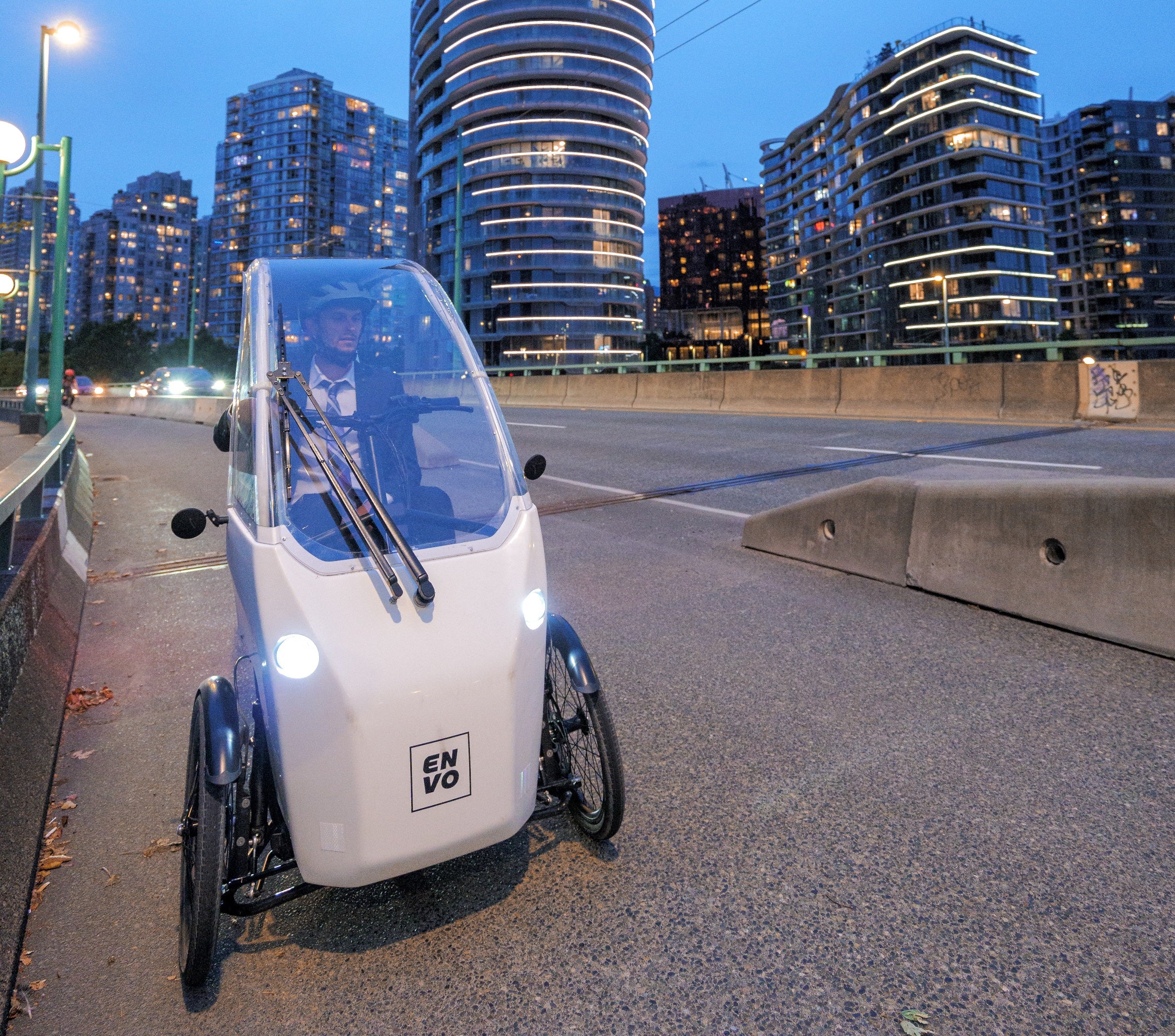
The Veemo SE is the most practical successor to the Arcimoto FUV concept. Built by VeloMetro Mobility (powered by Envo Drive Systems) in Vancouver, Canada, the Veemo SE is a fully enclosed, pedal-assist electric trike designed for daily commuting in Canadian conditions.
Why it is the best alternative:
- Price: $6,999 CAD — a fraction of the FUV's $17,900–$24,000 USD price tag
- No license required — classified as an e-bike, not a motorcycle. This single difference eliminates the biggest barrier that killed the FUV's market reach
- No insurance required — saves $500–$1,500 per year compared to the FUV's mandatory motorcycle insurance
- No registration required — no DMV visits, no plates, no annual renewal fees
- Fully enclosed — complete weather protection from rain, snow, and wind. The FUV's canopy left riders partially exposed; the Veemo provides full cabin enclosure with windshield and wiper
- Pedal assist with health benefits — unlike the FUV, which was throttle-driven, the Veemo combines electric assist with pedaling for an active commute
- Actually shipping — order one and receive it. Ships across Canada and North America
- Real company with real support — based in Vancouver with actual customer service, parts inventory, and warranty support
For Canadians exploring the e-bike and micro-EV space, eBike BC provides a useful overview of the urban commuter e-bike category and how enclosed velomobiles fit within it. The Veemo FAQ page addresses Canada-specific regulatory questions in detail.
2. Veemo LT — Best for Cargo and Delivery
The Veemo LT is the cargo-oriented variant, priced at $5,999 CAD. If you were interested in Arcimoto's Deliverator concept — the delivery-focused FUV variant that never reached production — the Veemo LT is what that product should have been: an affordable, enclosed, pedal-assist cargo trike that requires no motorcycle license or commercial vehicle registration.
3. PEBL by Better Bike
The PEBL (Pedal Electric Big Load) is another enclosed pedal-electric vehicle. Manufactured in the United States, the PEBL offers a fully enclosed cabin with pedal assist at approximately $9,995–$11,000 USD. It is a solid product but significantly more expensive than the Veemo SE, and has historically had longer lead times. The higher price point weakens the value proposition against a used car.
4. Hopper Mobility
Hopper Mobility is a Swedish startup developing an enclosed electric velomobile targeting European urban commuters. Estimated at approximately EUR 6,990, it remains in pre-order or early production phase in Europe and is not currently available in North America. It faces the same pre-revenue startup risks that plagued early Arcimoto.
5. Electrom
Electrom is a Canadian-designed enclosed electric velomobile with an aerodynamic design and solar panel option, priced at approximately $12,500 CAD. The range claims are impressive, but at nearly double the Veemo SE's price and still in early production, availability and support remain uncertain.
| Feature | Arcimoto FUV | Veemo SE | Veemo LT | PEBL | Hopper | Electrom |
|---|---|---|---|---|---|---|
| Price | $17,900–$24,000 USD | $6,999 CAD | $5,999 CAD | $9,995–$11,000 USD | ~EUR 6,990 | ~$12,500 CAD |
| License Required | Yes (motorcycle) | No | No | No | No | No |
| Insurance Required | Yes (motorcycle) | No | No | No | Varies | No |
| Full Enclosure | Partial (open sides) | Yes | Yes | Yes | Yes | Yes |
| Pedal Assist | No (throttle only) | Yes | Yes | Yes | Yes | Yes |
| Bike Lane Legal | No | Yes | Yes | Yes | Yes | Yes |
| Currently Shipping to Canada | Defunct | Yes | Yes | Limited (US only) | No | Pre-order |
| Annual Operating Cost | $2,000+ (insurance, registration, electricity) | ~$250 | ~$250 | ~$300 | TBD | ~$300 |
Why Veemo Succeeds Where Arcimoto Failed
The comparison table above tells a clear story, but it is worth examining the specific strategic decisions that differentiate Veemo from Arcimoto.
E-Bike Classification Changes Everything
Arcimoto's fatal flaw was building a vehicle that regulators classified as a motorcycle. This single decision created a cascade of problems: license requirements excluded most buyers, insurance costs inflated ownership expenses, and the motorcycle label scared off the safety-conscious commuters who were the natural target market.
The Veemo SE avoids this entirely. By designing within e-bike speed and power limits, Veemo ensures that no license, registration, or insurance is required. The addressable market is not "people who have a motorcycle license and want an EV." It is "anyone who can ride a bike." That is a fundamentally larger market.
Price Point That Makes Economic Sense
The Arcimoto FUV at $20,000+ was competing against used cars and affordable new cars. At that price, most consumers chose a conventional vehicle with four wheels, climate control, and a proven dealer network. At $6,999 CAD, the Veemo SE is priced as a transportation appliance — cheaper than a year of car ownership in most Canadian cities, and cheaper than many e-bikes with far less capability. The math works not as a luxury purchase but as a cost-saving tool. For a full breakdown, eBike BC's buying guide covers the key financial questions well.
Sustainable Manufacturing Model
Arcimoto tried to build a vertically integrated EV manufacturing operation from scratch, requiring hundreds of millions in capital. They never achieved the volume necessary to amortize those fixed costs, resulting in massive per-unit losses. Veemo, built by VeloMetro Mobility and powered by Envo Drive Systems, leverages existing bicycle and e-bike supply chains. The manufacturing complexity of an enclosed e-bike trike is orders of magnitude lower than a highway-speed autocycle, allowing Veemo to operate profitably at much lower volumes.

Real-World 5-Year Cost Comparison: Arcimoto FUV vs. Veemo SE
| Cost Category | Arcimoto FUV (5-Year) | Veemo SE (5-Year) |
|---|---|---|
| Purchase Price | $20,000 USD (~$27,000 CAD) | $6,999 CAD |
| Insurance (5 years) | $5,000+ ($1,000/yr motorcycle insurance) | $0 (not required) |
| Registration (5 years) | $500 ($100/yr) | $0 (not required) |
| Electricity (5 years) | $750 | $250 |
| Maintenance (5 years) | $2,500 | $1,000 |
| Parking (5 years) | $6,000 ($100/mo urban) | $0 (bike parking) |
| 5-Year Total Cost | ~$34,750 USD / ~$47,000 CAD | $8,249 CAD |
The five-year cost difference is staggering. Even converted to the same currency, the Veemo SE costs less than a fifth of what FUV ownership would have cost. And unlike the FUV, your Veemo will still have manufacturer support, parts availability, and residual value in five years.
Who Should Consider a Veemo Instead of Waiting for an Arcimoto Successor?
If any of these describe you, the Veemo SE or Veemo LT deserves a serious look:
- Former Arcimoto FUV owners who need a replacement as parts and support dry up
- People who loved the FUV concept but were deterred by the motorcycle license requirement
- Commuters with a 5–25 km daily one-way trip who want weather protection without car expenses
- Anyone who reserved an Arcimoto and never received delivery
- E-bike shoppers who want full weather protection — not just a rain jacket
- Second-vehicle households looking to replace the car used for errands and short commutes
- Environmentally conscious commuters who want zero-emission transportation with exercise benefits
- Delivery businesses looking at the Veemo LT as a practical cargo solution without commercial vehicle registration
Frequently Asked Questions
The Practical Alternative Is Here
Everything Arcimoto promised — full enclosure, zero emissions, affordable commuting — without the motorcycle license, the vaporware delays, or the bankruptcy risk.
Explore Veemo SE See Veemo LT