
Bicycle Car for Sale: The Rise of Enclosed E-Bikes in 2026
There is a vehicle category that has existed for over a century but is only now hitting its stride. It is too fast and protected to be called a bicycle. It is too small and efficient to be called a car. People call it a bicycle car — and in 2026, these hybrid vehicles are finally ready for the mainstream.
If you have been searching for a "bicycle car for sale," you are part of a rapidly growing movement of commuters who want something between a traditional bike and a traditional car. You want pedal power with weather protection. You want exercise with comfort. You want efficiency without vulnerability. This guide covers everything you need to know about bicycle cars: what they are, where they came from, what is available today, and where to buy one. Spoiler: the Veemo SE is the best bicycle car you can buy in 2026.

What Exactly Is a Bicycle Car?
A bicycle car — also called a velomobile, pedal car, human-powered vehicle (HPV), or enclosed e-trike — is a vehicle that combines the pedal-powered, human-scale nature of a bicycle with the weather protection, stability, and enclosed cabin of a car. It bridges two worlds that have traditionally been separate.
The key characteristics of a bicycle car include:
- Human-powered (usually with electric assist): You pedal, often with a motor supplementing your effort.
- Enclosed cabin: A roof and body panels protect you from weather and provide crash protection.
- Three or four wheels: Multiple wheels provide stability without the need for balance.
- Compact size: Smaller than a car, able to use bike infrastructure in many jurisdictions.
- Lightweight: Typically 50–150 kg, compared to 1,500+ kg for a car.
- No fuel required: Electric charging and human power replace gasoline.
- Low or no registration requirements: Classified as e-bikes in most jurisdictions.
Think of a bicycle car as the answer to a question many commuters have been asking: "Why do I need a 2,000 kg machine to move my 80 kg body 10 km to work?"
A Brief History of the Bicycle Car
The concept of a bicycle car is not new. Inventors have been trying to merge bicycles and cars since both vehicles existed. Understanding this history helps explain why 2026 is the year bicycle cars are finally going mainstream.
The Early Days: 1920s–1960s
The first enclosed human-powered vehicles appeared in the early 20th century. European inventors created streamlined recumbent bicycles with fairings — shell-like covers that reduced wind resistance. These were primarily racing vehicles, not practical transportation. The Mochet Velocar from France in the 1930s was one of the first commercially produced pedal cars, featuring a lightweight body and recumbent seating. It saw modest success before World War II disrupted production.
The Velomobile Movement: 1970s–2000s
The oil crises of the 1970s sparked renewed interest in human-powered transportation. Dutch and German engineers developed modern velomobiles — fully enclosed, aerodynamic, pedal-powered vehicles. Companies like Alleweder, Leitra, and WAW produced small batches of velomobiles that attracted dedicated enthusiasts. Without electric assist, however, they required serious fitness to operate, limiting their appeal to athletic riders.
The Electric Revolution: 2010s–2020s
Everything changed when electric assist motors and lithium-ion batteries became affordable and compact. Suddenly, enclosed pedal vehicles did not require the fitness level of a competitive cyclist. Anyone could ride one comfortably. Companies like ELF, Organic Transit, and PodRide released electrically assisted enclosed cycles. Interest surged, but early models still suffered from limited range, questionable build quality, and high prices relative to their capabilities.
The Modern Era: 2024–2026
Today, advances in battery technology, lightweight composites, electric motor efficiency, and manufacturing techniques have brought bicycle cars to a tipping point. Vehicles like the Veemo SE and Veemo LT represent a new generation of bicycle cars that are practical, reliable, attractive, and affordable enough for everyday commuters. The infrastructure is catching up too, with more cities building protected bike lanes wide enough for these vehicles. You can browse the current range of urban commuter e-bikes to see how the broader market has evolved.
Why the Term "Bicycle Car" Matters
Language shapes perception. When people search for "bicycle car for sale," they are expressing a specific need that neither "bicycle" nor "car" alone satisfies. This linguistic bridge reflects a real gap in the transportation market.
More Than a Bicycle
Standard bicycles — even electric ones — leave riders exposed to weather, vulnerable in traffic, and limited in cargo capacity. A bicycle car addresses all three limitations while retaining the bicycle's advantages: low cost, exercise benefits, environmental friendliness, and access to cycling infrastructure. For anyone still evaluating whether a standard e-bike suffices, the EbikeBC buying guide offers useful comparison criteria.
Less Than a Car
Cars are expensive, space-consuming, polluting, and often slower than bicycles in urban traffic when you factor in parking. A bicycle car eliminates car ownership costs while providing the protection and comfort that make cycling viable year-round.
Types of Bicycle Cars Available in 2026
Traditional Velomobiles
Fully faired recumbent trikes, typically without electric assist or with minimal assist. Brands like WAW, Milan, and DF continue to produce these for enthusiasts. They are fast and aerodynamic but require fitness, have limited cargo space, and cost $5,000–$15,000. Best suited for athletic riders and cycling enthusiasts rather than everyday commuters.
DIY and Kit Bicycle Cars
Several companies offer plans or kits to build your own bicycle car. The PodRide-style DIY approach appeals to makers and tinkerers. Costs range from $1,000–$4,000 for materials. Quality varies enormously, safety is not certified, and building requires significant time and mechanical skill.
Micro-Cars and Neighbourhood Electric Vehicles (NEVs)
Vehicles like the Citroen Ami, Renault Twizy, and various Chinese micro-cars share some bicycle car DNA but are fully motorized with no pedal input. They are classified as cars (not bikes), require registration and insurance, and cannot use bike infrastructure. They occupy a different regulatory and practical category, though they serve a similar niche of ultralight urban transportation.
Enclosed Electric Trikes (The Best of Both Worlds)
This is the category that truly earns the "bicycle car" label. Vehicles like the Veemo SE combine pedal-assist electric power with full enclosure, three-wheel stability, and purpose-built design. They are classified as e-bikes in most jurisdictions, require no registration or insurance in many areas, and can use cycling infrastructure while providing car-like comfort and protection. The motor systems are developed by ENVO Drive Systems, a Canadian electric drivetrain specialist.
Bicycle Cars for Sale: What Is on the Market in 2026
| Model | Type | Enclosure | Electric Assist | Wheels | Approx. Price | Availability |
|---|---|---|---|---|---|---|
| Veemo SE | Enclosed e-trike | Full | Yes | 3 | Contact for pricing | Canada / North America |
| Veemo LT | Enclosed e-trike | Full | Yes | 3 | Contact for pricing | Canada / North America |
| CityQ | Enclosed e-quad | Full | Yes | 4 | ~$6,000–$8,000 | Europe (limited) |
| Frikar | Enclosed e-quad | Full | Yes | 4 | ~$7,000–$9,000 | Europe (pre-order) |
| Podbike | Enclosed e-quad | Full | Yes | 4 | ~$5,500–$7,500 | Europe (limited) |
| WAW Velomobile | Velomobile | Full | Optional | 3 | $8,000–$12,000 | Europe |
| ELF | Solar e-trike | Partial | Yes | 3 | ~$9,000–$11,000 | USA (limited) |
Prices and availability are approximate and subject to change. Contact manufacturers directly for current pricing.
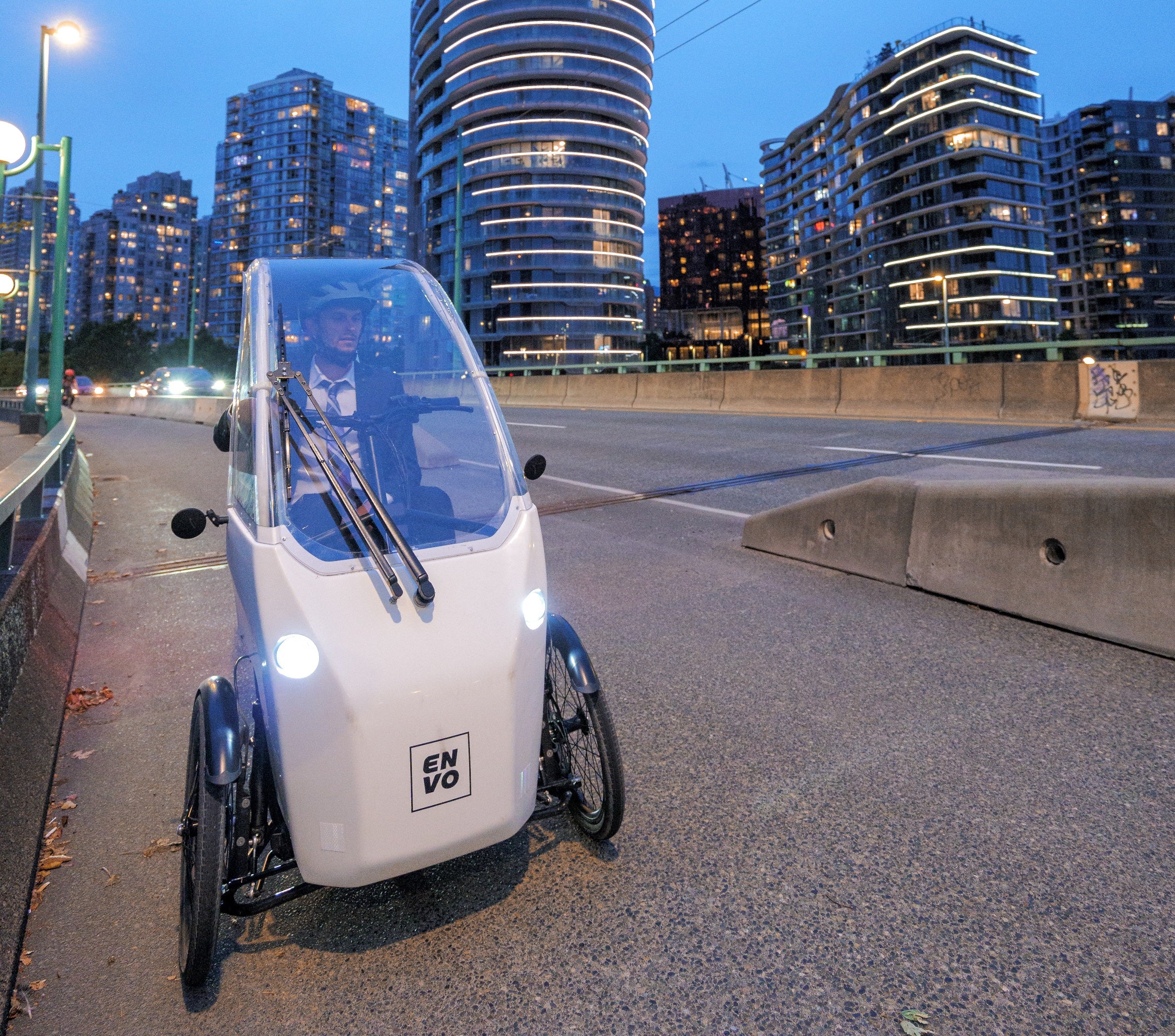
Why the Veemo Is the Best Bicycle Car for Canadian Buyers
Designed for Canadian Climate
Most bicycle cars on the market were designed in Western Europe, where winters are milder than in much of Canada. The Veemo was designed and built in Canada, with specific consideration for Canadian winters, rain seasons, and temperature extremes. Every seal, material, and system is tested against real Canadian weather conditions.
North American Availability and Support
Buying a European bicycle car from Canada means international shipping, customs duties, currency conversion, and limited warranty support. The Veemo is sold directly in Canada with local customer support, warranty service, and parts availability. If something needs attention, you are not shipping a vehicle across the Atlantic.
Many bicycle cars were designed by cycling enthusiasts for cycling enthusiasts. The Veemo was designed for everyday commuters — people who might not identify as cyclists but need practical, affordable, all-weather transportation. Easy entry and exit, intuitive controls, comfortable upright seating, and integrated cargo space for work bags and groceries. Visit the Veemo FAQ for answers to practical pre-purchase questions.
Regulatory Compliance
The Veemo is designed to meet Canadian e-bike regulations, meaning it can be ridden on bike paths and lanes in most jurisdictions without registration, insurance, or a driver's license. This is a critical advantage over micro-cars and NEVs that require full vehicle registration.
Canadian Engineering and Build Quality
Veemo brings Canadian engineering standards to the bicycle car category. The structural design, electrical systems, and material choices reflect the quality expectations of the North American market. The electric drivetrain is developed in partnership with ENVO Drive Systems. Every vehicle undergoes thorough quality control before delivery.
Where to Buy a Bicycle Car in Canada
Direct from Veemo
The most straightforward option for Canadian buyers. Visit veemo.ca to explore the Veemo SE and Veemo LT, request pricing, and place an order. Direct purchasing means no dealer markups and direct communication with the manufacturer.
Import from Europe
Some European bicycle car manufacturers ship to North America. Expect to add $1,000–$3,000 in shipping and customs costs, plus potential compatibility issues with North American electrical standards. Warranty service will be limited or nonexistent locally.
Used Market
The used bicycle car market is still small but growing. Check local classified sites, e-bike forums, and velomobile communities. Inspect used vehicles carefully — enclosed e-bikes have complex systems that require knowledgeable evaluation.
Specialty Retailers
Specialty e-bike retailers like EbikeBC carry a wide range of electric urban commuters and can provide hands-on guidance for buyers exploring alternatives to standard e-bikes.
The Economics of Owning a Bicycle Car
| Expense Category | Compact Car | Bicycle Car (Veemo) | Annual Savings |
|---|---|---|---|
| Vehicle Payment (monthly) | $400–$600 | $0 (after purchase) | $4,800–$7,200 |
| Insurance | $1,200–$2,400 | $0–$200 | $1,000–$2,200 |
| Fuel / Electricity | $1,800–$3,000 | $50–$100 | $1,700–$2,900 |
| Parking | $1,200–$3,600 | $0–$200 | $1,000–$3,400 |
| Maintenance | $800–$1,500 | $100–$300 | $500–$1,200 |
| Registration | $100–$300 | $0 | $100–$300 |
| Total Annual Cost | $5,500–$11,400 | $150–$800 | $5,100–$10,900 |
For a household that can replace a second car with a Veemo, the savings are transformative — potentially $5,000–$10,000+ per year back in your pocket.
Who Should Buy a Bicycle Car?
Bicycle cars are not for everyone, but they are perfect for a surprisingly large segment of commuters. You are an ideal candidate if:
- Your commute is under 20 km each way: This covers the majority of urban commutes in Canada.
- You want to cycle but weather stops you: The number one reason bicycle cars exist.
- You want to reduce car dependency: Replace a second car or eliminate car ownership entirely.
- You value exercise during your commute: Pedal-assist means you choose your effort level.
- You are tired of traffic and parking hassles: Bicycle cars navigate congestion and park in compact spaces.
- You care about environmental impact: Near-zero emissions transportation.
- You want to arrive at work presentable: No sweat, no rain gear, no helmet hair.

Common Concerns About Bicycle Cars (Honest Answers)
Are they fast enough?
Most bicycle cars reach 25–32 km/h with pedal assist, which is the legal e-bike speed limit in Canada. In urban traffic with stops and signals, this is often comparable to car speed. You are not highway-capable, but for city commuting, speed is rarely the limiting factor — traffic, parking, and route flexibility matter more.
Are they safe?
Enclosed bicycle cars like the Veemo are safer than open bicycles in several ways: a rigid body provides crash protection, three wheels eliminate tip-over risk, the enclosed design improves visibility to other road users, and integrated lighting with turn signals communicates your intentions clearly.
Can they handle hills?
Electric assist makes hills manageable regardless of your fitness level. Modern bicycle cars with quality motors handle grades of 10–15% without difficulty. The Veemo's electric assist system — built on technology from ENVO Drive Systems — is specifically tuned for the hilly terrain found in many Canadian cities.
This is where bicycle cars truly shine versus standard bikes. The full enclosure keeps you warm and dry. Three wheels provide stability on slippery surfaces. With appropriate tires, bicycle cars are viable winter transportation — something that cannot be said for most standard bikes. The Veemo LT is designed for year-round Canadian use, including winter.
Frequently Asked Questions
Ready to Ride Smarter?
The Veemo is Canada's premier bicycle car — fully enclosed, electrically assisted, and built for real Canadian commuting.
Explore Veemo SE See Veemo LT