
Velomobile vs Car: A Realistic Comparison for Daily Commuters
Velomobile vs Car: A Realistic Comparison for Daily Commuters
Can a velomobile actually replace a car for daily commuting? It is a fair question — and the honest answer is: it depends. For many Canadian commuters, an enclosed electric velomobile like the Veemo SE can fully replace a second car (or even a primary car) while saving thousands of dollars per year. For others, it works best as a complement to car ownership, handling the daily commute while the car handles weekend trips and heavy hauling.
This guide provides a realistic, data-driven comparison between velomobiles and cars for daily commuting in Canada. We cover every cost, every trade-off, and every scenario — so you can make an informed decision based on your specific situation.

The Annual Cost Comparison: Velomobile vs Car
Let us start with the numbers. Below is a detailed annual cost comparison using 2026 Canadian data for a typical commuter driving or riding 30 km each way (60 km round trip) in a major city like Vancouver, Toronto, or Montreal.
Annual Cost Breakdown
| Expense Category | Velomobile (Veemo SE) | Used Car ($20K) | New Car ($40K) | Electric Car ($45K) |
|---|---|---|---|---|
| Vehicle Payment (5-year) | ~$150/mo* | ~$400/mo | ~$700/mo | ~$800/mo |
| Annual Payment Total | ~$1,800 | $4,800 | $8,400 | $9,600 |
| Insurance | $0–$200 (optional) | $1,800–$2,400 | $2,000–$3,000 | $2,200–$3,200 |
| Fuel / Electricity | $15–$30 (charging) | $2,400–$3,600 | $2,400–$3,600 | $400–$600 |
| Parking (downtown) | $0 (bike parking) | $2,400–$4,800 | $2,400–$4,800 | $2,400–$4,800 |
| Maintenance | $100–$300 | $1,200–$2,000 | $600–$1,200 | $300–$600 |
| Registration | $0 | $100–$200 | $100–$200 | $100–$200 |
| License Fees | $0 | $75–$90 | $75–$90 | $75–$90 |
| TOTAL ANNUAL COST | $1,915–$2,330 | $12,775–$17,890 | $15,975–$21,290 | $15,075–$19,090 |
| Annual Savings vs Velomobile | -- | $10,000–$16,000 | $13,000–$19,000 | $12,000–$17,000 |
*Veemo financing estimate. Contact veemo.ca for current pricing and financing terms.
The numbers are striking. Even compared to a modest used car, a velomobile saves $10,000 to $16,000 per year. Over five years, that is $50,000 to $80,000 in savings — enough for a down payment on a home in many Canadian markets.
5-Year Total Cost of Ownership
| Vehicle | 5-Year Total Cost | Savings vs Used Car |
|---|---|---|
| Veemo SE (velomobile) | $10,000–$12,000 | $54,000–$78,000 |
| Used car ($20K purchase) | $64,000–$90,000 | -- |
| New car ($40K purchase) | $80,000–$106,000 | N/A |
| Electric car ($45K purchase) | $75,000–$95,000 | N/A |
Speed and Commute Time Comparison
One of the biggest concerns commuters have about switching from a car to a velomobile is travel time. Here is the reality:
| Vehicle | Average Urban Speed | 15 km Commute Time | 30 km Commute Time |
|---|---|---|---|
| Car (with traffic) | 20–35 km/h | 25–45 min | 50–90 min |
| Car (no traffic) | 40–60 km/h | 15–22 min | 30–45 min |
| Velomobile (bike lanes) | 22–32 km/h | 28–40 min | 56–80 min |
| Regular e-bike | 20–30 km/h | 30–45 min | 60–90 min |
| Public transit | 15–25 km/h (incl. stops) | 35–60 min | 70–120 min |
The key insight: in rush-hour traffic, a velomobile is often comparable to or faster than a car. While a car might have a higher top speed, it spends significant time stopped in traffic, circling for parking, and walking from the parking lot to the final destination. A velomobile uses bike lanes to bypass congestion and parks at the door.
For commutes under 15 km, a velomobile like the Veemo SE is typically within 5–10 minutes of a car's travel time during rush hour. For commutes over 25 km, a car has a meaningful speed advantage outside of heavy traffic conditions. Learn more about urban cycling infrastructure from eBike BC's urban commuter resources.
Range and Distance: How Far Can You Realistically Commute?
The Veemo SE delivers over 80 km of range on a single charge. This comfortably covers round-trip commutes of up to 35–40 km each way, even accounting for cold weather battery reduction and hills.
| Conditions | Expected Range | Max One-Way Commute |
|---|---|---|
| Warm weather, flat terrain | 90–100+ km | 45–50 km |
| Moderate weather, some hills | 70–85 km | 35–40 km |
| Cold weather (-10°C), hilly | 55–65 km | 25–30 km |
| Extreme cold (-20°C), heavy hills | 45–55 km | 20–25 km |
If your commute is within these ranges, a velomobile works as a daily driver. If your commute exceeds 40 km each way, you may want to explore workplace charging or consider a velomobile as a complement to a car rather than a full replacement.

Weather Protection: Can a Velomobile Handle Canadian Weather?
This is where enclosed velomobiles like the Veemo separate themselves from regular e-bikes. Let us compare weather capabilities honestly:
| Weather Condition | Car | Veemo (Enclosed Velomobile) | Regular E-Bike |
|---|---|---|---|
| Light rain | No impact | No impact (enclosed + wiper) | Rider gets wet |
| Heavy rain | No impact | Rider stays dry | Miserable |
| Snow (light) | No impact | Rider stays dry; traction varies | Dangerous on two wheels |
| Snow (heavy) | Manageable with winter tires | Manageable with studded tires | Not recommended |
| Wind (-30+ km/h gusts) | No impact | Protected; slight speed reduction | Difficult and dangerous |
| Extreme cold (-20°C) | Heated cabin | Enclosed + body heat; dress warmly | Exposed; frostbite risk |
| Summer heat (30°C+) | Air conditioned | Ventilation; can be warm | Breeze from riding |
A car still wins on extreme weather comfort thanks to heating and air conditioning. But the Veemo closes the gap dramatically compared to an open e-bike. Many riders report that body heat generated from pedaling, combined with the enclosed cabin's wind protection, keeps them comfortable down to -10°C with appropriate clothing.
Downtown Vancouver Office Worker: 12 km commute — by car: 30–45 min + $300/month parking + $200 gas + $200 insurance = $700/month. By Veemo: 25–35 min, $0 parking, $2 electricity = ~$150/month (financing). Monthly savings: $550.
Exercise and Health Benefits
One major advantage that a velomobile has over both cars and regular e-bikes is the combination of exercise with weather protection.
| Vehicle | Calories Burned (30 min commute) | Annual Exercise Equivalent |
|---|---|---|
| Car | ~30 (sitting) | Negligible |
| Public transit | ~50 (walking to/from stops) | Minimal |
| E-bike / Velomobile (pedal-assist) | 150–250 | ~75,000–125,000 cal/year |
| Regular bicycle | 250–400 | ~125,000–200,000 cal/year |
Commuting by velomobile with pedal assist gives you a moderate workout equivalent to a brisk walk or light jog — enough to meet Health Canada's recommended 150 minutes of moderate physical activity per week, simply by commuting. Unlike a regular bicycle, however, you get this exercise benefit without arriving at work sweaty, wind-blown, or rain-soaked.
Environmental Impact Comparison
| Factor | Velomobile | Gas Car | Electric Car |
|---|---|---|---|
| CO2 per km (operating) | ~0 g | 150–250 g | 0–50 g* |
| Annual CO2 (15,000 km) | ~0 kg | 2,250–3,750 kg | 0–750 kg* |
| Manufacturing footprint | Low (~500 kg CO2) | High (~6,000–8,000 kg CO2) | Very high (~10,000–15,000 kg CO2) |
| Battery size | ~0.5–1 kWh | N/A | 40–100 kWh |
| Road wear | Negligible (~65 kg) | Significant (~1,500–2,500 kg) | Higher (~2,000–3,000 kg) |
| Parking space needed | Bike parking (~1 m²) | Full parking spot (~12 m²) | Full parking spot (~12 m²) |
*Electric car CO2 depends on electricity source. In BC and Quebec (hydroelectric), it is near zero. In Alberta and Saskatchewan (natural gas/coal), it is higher.
When a Velomobile Works as a Car Replacement
Based on the data above, here are the scenarios where a velomobile like the Veemo SE or Veemo LT can realistically replace a car:
- Daily commute under 30 km each way: The Veemo's 80+ km range handles this easily, even in winter.
- Urban or suburban environment: Bike lanes, multi-use paths, and lower-speed roads make velomobile commuting safe and efficient.
- Household with multiple cars: Replace the second (or third) car with a velomobile. Keep one car for road trips and heavy hauling.
- Commuter who also wants exercise: Get your workout and your commute done simultaneously.
- Anyone paying for downtown parking: Eliminating $200–$400/month in parking fees alone justifies the switch.
- Retirees and seniors: Three-wheel stability, no license required, low cost, and gentle exercise make velomobiles ideal for active seniors.
- Students and young professionals: Avoid car payments, insurance, and gas while staying mobile and independent.
The "Two-Vehicle Household" Strategy
For many Canadian families, the most practical approach is replacing the second car with a velomobile. Here is how this strategy works financially:
| Scenario | Annual Cost |
|---|---|
| Two cars (one new, one used) | $28,000–$39,000 |
| One car + one velomobile | $17,000–$23,000 |
| Annual savings | $11,000–$16,000 |
By replacing the second car with a Veemo SE, a typical Canadian household saves $11,000 to $16,000 per year while maintaining full mobility. The car handles road trips and heavy cargo. The velomobile handles the daily commute — which accounts for 80% or more of household vehicle use. For more context on Canadian e-bike buying decisions, see eBike BC's buyer's guide.
Practical Considerations for Switching
Storage
A velomobile is larger than a regular bicycle but far smaller than a car. The Veemo fits in a single car parking spot or a standard garage. Some riders store their velomobile in a backyard shed, covered bike parking, or even a large hallway in an apartment building.
Grocery Shopping
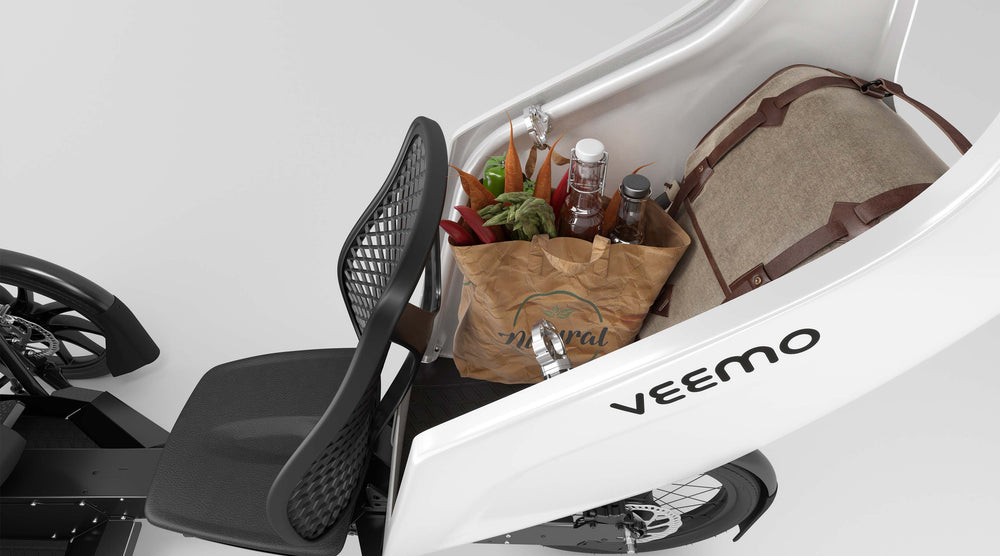
The Veemo SE includes a rear cargo area that can handle 2–3 bags of groceries. For larger shopping trips, most velomobile commuters make more frequent smaller shopping trips or use the household car for the monthly bulk shop.
Professional Appearance
Unlike riding a regular bike, commuting by velomobile allows you to arrive at work dry, presentable, and not overheated. The enclosed cabin protects your clothing and hair from wind and rain. Many professional commuters report that colleagues do not even realize they cycled to work.
Maintenance
Velomobile maintenance is dramatically simpler and cheaper than car maintenance. Typical annual maintenance includes tire replacement ($50–$100), brake pad replacement ($20–$40), chain/belt replacement ($30–$60), and general inspection ($50–$100). Total annual maintenance: $100–$300, compared to $600–$2,000+ for a car. Visit Veemo's FAQ page for maintenance guidance.
Frequently Asked Questions
Save $10,000+ Per Year
Replace your daily commute car with a Veemo enclosed electric velomobile. Full weather protection, zero fuel costs, no insurance required, and financing available.
Explore Veemo SE Explore Veemo LT