
Winter Commuting with an Enclosed Electric Bike: The All-Season Advantage
Every fall, millions of Canadians face the same frustrating decision: keep cycling through winter or give up and drive. The vast majority choose the car. According to Statistics Canada, cycling mode share drops by 70–90% in winter months compared to summer in most Canadian cities. The reason is obvious — nobody wants to ride an open bicycle through freezing rain, snowstorms, and minus-twenty wind chills.
But what if the weather was not a factor? What if you could pedal to work in January wearing the same clothes you wore in July? That is exactly what an enclosed electric bike — specifically, a covered bicycle or enclosed e-trike like the Veemo SE — makes possible. In this guide, we explain why enclosed e-bikes solve the number one barrier to winter cycling, how they perform in Canadian conditions, and why they are the key to true year-round bike commuting.

The Number One Barrier to Winter Cycling: Weather Exposure
Surveys consistently show that weather is the primary reason people stop cycling in winter — not distance, not fitness, not safety concerns. Specifically: cold temperatures expose skin and extremities painfully; precipitation soaks riders and creates dangerous visibility conditions; road spray from cars and trucks coats everything with salt-laden slush; ice on two wheels is terrifying; shorter days mean more riding in darkness; and dressing for winter cycling requires specialized (expensive) clothing while you still arrive sweaty under all those layers.
An enclosed electric bike eliminates or dramatically reduces every single one of these barriers. That is not an incremental improvement — it is a category change.
How an Enclosed E-Bike Solves Winter Cycling Challenges
Full Weather Protection
A covered electric bike like the Veemo SE surrounds the rider in a protective cabin. Rain, snow, sleet, and wind hit the enclosure, not you. The enclosure blocks rain and snow from all directions (not just above), wind chill at cycling speeds, road spray from passing vehicles, and salt spray that corrodes components and ruins clothing.
No Special Winter Gear Required
| Winter Gear Item | Cost | Required for Open Bike | Required in Veemo |
|---|---|---|---|
| Windproof outer layer | $100–$300 | Yes | No |
| Winter cycling gloves | $40–$120 | Yes | No |
| Insulated cycling shoes | $80–$200 | Yes | No |
| Balaclava / neck gaiter | $20–$60 | Yes | No |
| Total | $240–$680 | All of it | None |
In an enclosed e-bike, you wear your regular clothes — whatever you would wear walking from your front door to your car. You arrive at work in office clothes, not drenched in sweat under four layers of technical fabric.
Open-bike winter cycling demands $240–$680 in specialized gear and adds 10–15 minutes to each trip for layering up. In an enclosed e-bike, you wear regular clothes and step in just like getting into a car.
Battery Performance in Cold Weather
Cold temperatures are hard on lithium-ion batteries. An e-bike battery left exposed to minus-20 Celsius can lose 30–50% of its capacity. Enclosed e-bikes have a natural advantage here — the cabin provides insulation that keeps the battery warmer than ambient temperature, especially during riding when your body heat and the motor's waste heat warm the interior. This means less range loss in cold weather, better battery longevity, and more consistent performance through the winter season.
Three-Wheel Stability on Slippery Surfaces
Ice and packed snow are dangerous on a two-wheeled bicycle. Even studded tires cannot prevent every slip, and a fall on ice at any speed can cause serious injury. The Veemo SE's three-wheel configuration provides inherent stability that two-wheeled bikes cannot match: no balance required at stops, three contact patches for better traction distribution, a lower center of gravity, and if one wheel slips on ice, the other two maintain stability.
Integrated Lighting for Dark Commutes
Canadian winter means short days. In December, many commuters ride to work and home in darkness. Enclosed e-trikes like Veemo include integrated lighting systems — headlights, taillights, and signal indicators powered by the vehicle's battery. No fumbling with clip-on bike lights that die mid-commute, no forgetting to charge separate light batteries.

Canadian Winter Conditions by City: Viability Guide
| City | Avg. January Temp | Avg. Annual Snowfall | Days Below -10°C | Enclosed E-Bike Viability |
|---|---|---|---|---|
| Vancouver, BC | 4.1°C | 38 cm | ~1 | Excellent — mild winters, mainly rain |
| Victoria, BC | 4.6°C | 25 cm | ~0 | Excellent — almost no snow |
| Toronto, ON | -3.7°C | 108 cm | ~30 | Very Good — cold but manageable in enclosure |
| Ottawa, ON | -10.2°C | 175 cm | ~65 | Good — very cold, cabin warmth essential |
| Montreal, QC | -8.9°C | 209 cm | ~55 | Good — heavy snow, but paths often cleared |
| Calgary, AB | -7.1°C | 128 cm | ~45 | Good — chinooks provide regular warm spells |
| Edmonton, AB | -11.7°C | 123 cm | ~75 | Moderate — extreme cold days may be uncomfortable |
| Winnipeg, MB | -16.4°C | 111 cm | ~90 | Moderate — Canada's coldest major city |
| Halifax, NS | -4.3°C | 154 cm | ~25 | Very Good — moderate cold, enclosure handles rain/wind |
Open E-Bike vs. Enclosed E-Bike in Winter
| Factor | Open E-Bike in Winter | Enclosed E-Bike in Winter |
|---|---|---|
| Rider Comfort at -10°C | Miserable without full winter gear | Comfortable in regular clothes |
| Rain/Sleet Protection | Rain jacket only; face, hands, legs exposed | Fully protected |
| Wind Chill Effect | Full exposure (20 km/h at -10°C = -18°C wind chill) | Blocked by enclosure |
| Road Salt Spray | Coats rider and bike; corrodes components | Hits enclosure, not rider; easier to clean |
| Battery Range Loss | 30–50% reduction in deep cold | Reduced loss due to cabin insulation |
| Clothing Required | 4+ layers, specialized winter cycling gear | Normal office/casual clothes |
| Time to Get Ready | 10–15 min (layering, gear check) | Same as walking to car |
| Arrival Condition | Sweaty under layers, cold extremities, helmet hair | Comfortable, dry, presentable |
| Ice/Snow Stability | Poor (2 wheels, high centre of gravity) | Good (3 wheels, low centre of gravity) |
| Visibility to Cars | Low (narrow profile, dark conditions) | High (wider profile, integrated lights) |
| Motivation to Ride | Requires daily willpower battle | Easy — feels like getting in a small car |
The Psychology of Year-Round Commuting
Here is something that rarely gets discussed in e-bike reviews: the psychological barrier of winter cycling is as important as the physical one. Even experienced cyclists who own the right gear face a daily willpower battle during winter months.
At 6:30 AM on a dark, minus-fifteen morning, looking out at blowing snow, the thought of layering up and facing the elements on an open bike is enough to make most people reach for the car keys. It does not matter that you can physically do it — it matters that you do not want to, day after day, for five months straight.
An enclosed e-bike changes the equation entirely. Getting into an enclosed cabin is psychologically similar to getting into a car. You step in, sit down, and go. There is no gear ritual, no bracing yourself against the cold, no mental negotiation. The barrier to riding is the same in January as it is in June.
This is why enclosed e-bike owners ride year-round at dramatically higher rates than open bike owners. It is not about capability — it is about the daily decision being easy rather than hard.
The Financial Case for Year-Round Enclosed E-Bike Commuting
Most people who commute by bike in summer switch to cars, transit, or ride-sharing in winter. This "seasonal cycling" significantly reduces the financial benefits of bike commuting.
Seasonal Cyclist (May–October Only): 6 months of cycling savings on gas/transit ~$1,200–$2,400; 6 months of car/transit costs through winter ~$1,200–$2,400; net annual savings ~$0–$1,200 if keeping a car anyway.
Year-Round Enclosed E-Bike Commuter: 12 months of cycling savings on gas/transit ~$2,400–$4,800; potential to eliminate second car ~$8,000–$12,000/year; electricity cost for charging ~$20–$40/year; net annual savings ~$2,400–$12,000+.
Real Talk: Limitations of Winter E-Bike Commuting
- Heavy snowfall days — On days with 20+ cm of fresh, uncleared snow, cycling of any kind may be impractical until roads and paths are cleared. This typically means 5–15 days per winter in most Canadian cities.
- Extreme cold — At minus-30 and below, even an enclosed cabin will be cold. You will want a warm jacket — though nothing like full winter cycling gear for an open bike.
- Ice storms — True ice storms make all transportation dangerous. Stay home if you can.
- Reduced battery range — Even with cabin insulation, expect some range reduction in cold weather. Plan commutes within conservative range estimates.
Why Veemo Is Built for Canadian Winters
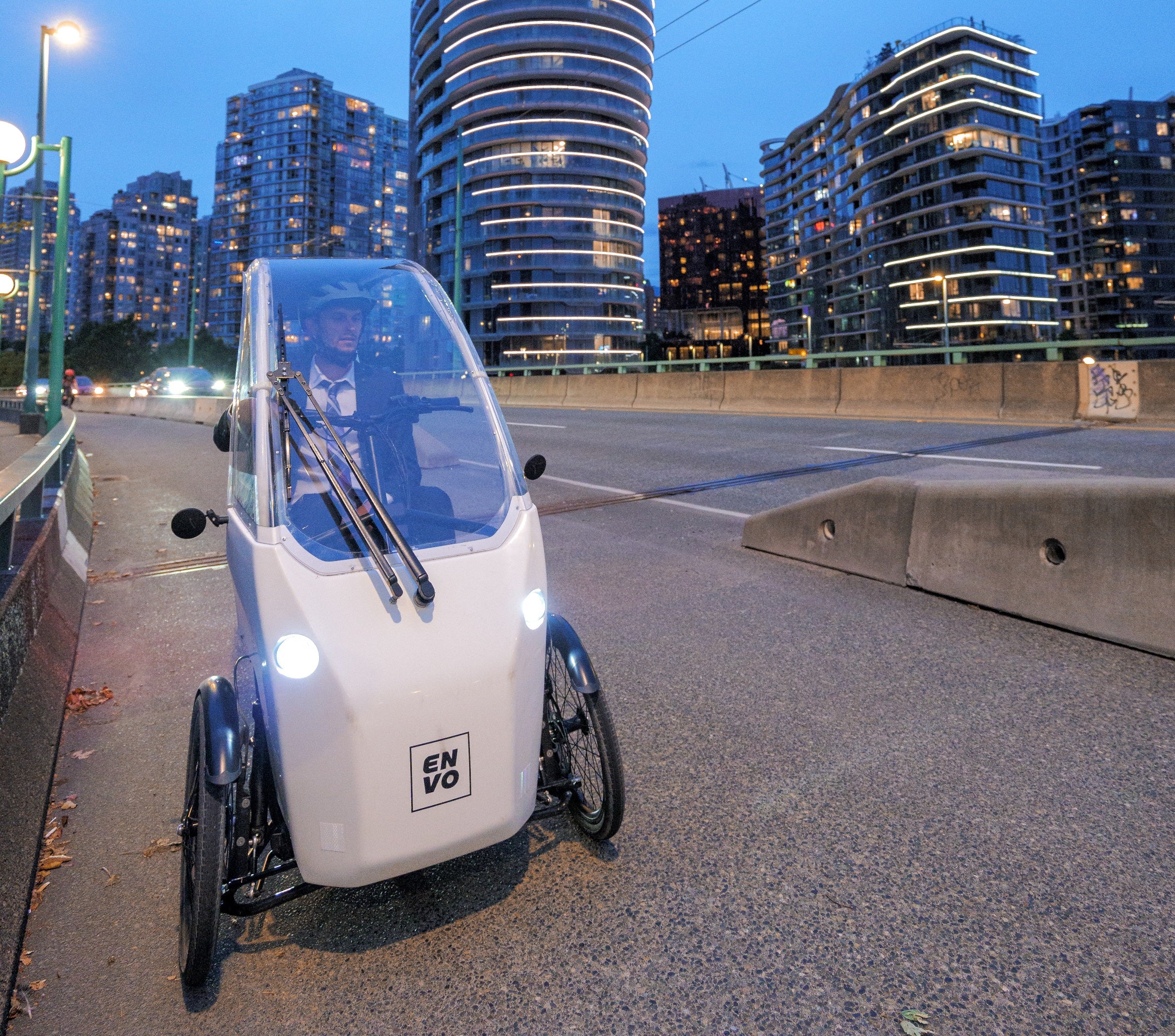
Not all enclosed e-bikes are created equal for winter performance. The Veemo SE, built by ENVO Drive Systems, has specific advantages for Canadian conditions: designed in Canada by Canadians who understand what minus-twenty and road salt mean for a vehicle; three-wheel stability critical for icy and snowy conditions; a complete cabin that blocks wind and precipitation from all angles; an enclosed battery compartment that maintains performance in cold weather; and integrated lighting essential for 16+ hours of winter darkness.
The Veemo LT extends these advantages to cargo and delivery use — imagine making winter deliveries in comfort, without idling a van in traffic and burning fuel to keep the heater running.
Getting Started: Your First Winter on an Enclosed E-Bike
- September–October: Purchase your enclosed e-bike and use pleasant fall weather to learn your commute route and get comfortable with the vehicle.
- November: As temperatures drop, you will appreciate the enclosure more each day. This is the easiest transition — you are already riding.
- December–February: Peak winter. Stay consistent. On heavy snow days, give yourself permission to skip — but you will likely find those days are rarer than expected.
- March: You made it through winter on a bike. Check the Veemo FAQ for maintenance tips after the salt season. Visit EbikeBC for accessory recommendations heading into spring.
Frequently Asked Questions
Stop Letting Winter Win.
Full enclosure, three-wheel stability, insulated battery, integrated lights. Designed for Canadian winters. No license or insurance required.
Explore Veemo SE View Veemo LT