
Best Enclosed Electric Bikes
Enclosed electric bikes have gone from niche curiosity to genuine transportation alternative. With prices ranging from $5,000 to over $15,000, choosing the wrong one is an expensive mistake. This guide breaks down every major option available in 2026, compares them honestly, and helps you figure out which one fits your life.
Whether you are commuting through Vancouver rain, navigating snowy Montreal streets, or just tired of arriving at work drenched in sweat, an enclosed ebike solves problems that regular bikes simply cannot.

What Is an Enclosed Electric Bike?
An enclosed electric bike (sometimes called an enclosed ebike, cabin bike, or velomobile) is a human-electric hybrid vehicle with a protective shell or canopy. Unlike a standard e-bike, an enclosed bicycle shields you from rain, wind, snow, and road spray. Most models are three-wheeled for stability, though designs vary significantly.
The key advantages over regular e-bikes include:
- All-weather riding: Rain, snow, and wind are no longer dealbreakers
- Improved safety: Better visibility to drivers, roll protection, and stability
- Cargo capacity: Most models carry groceries, bags, or even a child
- Year-round commuting: No seasonal gaps in your cycling routine
The trade-offs? They are heavier, wider, more expensive, and harder to store than a standard e-bike. Whether those trade-offs make sense depends entirely on how you plan to use it. You can learn more at the Veemo FAQ page or browse options at EbikeBC's urban commuter collection.
The 7 Best Enclosed Electric Bikes in 2026
We evaluated every enclosed electric bike currently available or shipping in North America. Here is how they stack up.
1. Veemo SE — Best Overall Enclosed Electric Bike
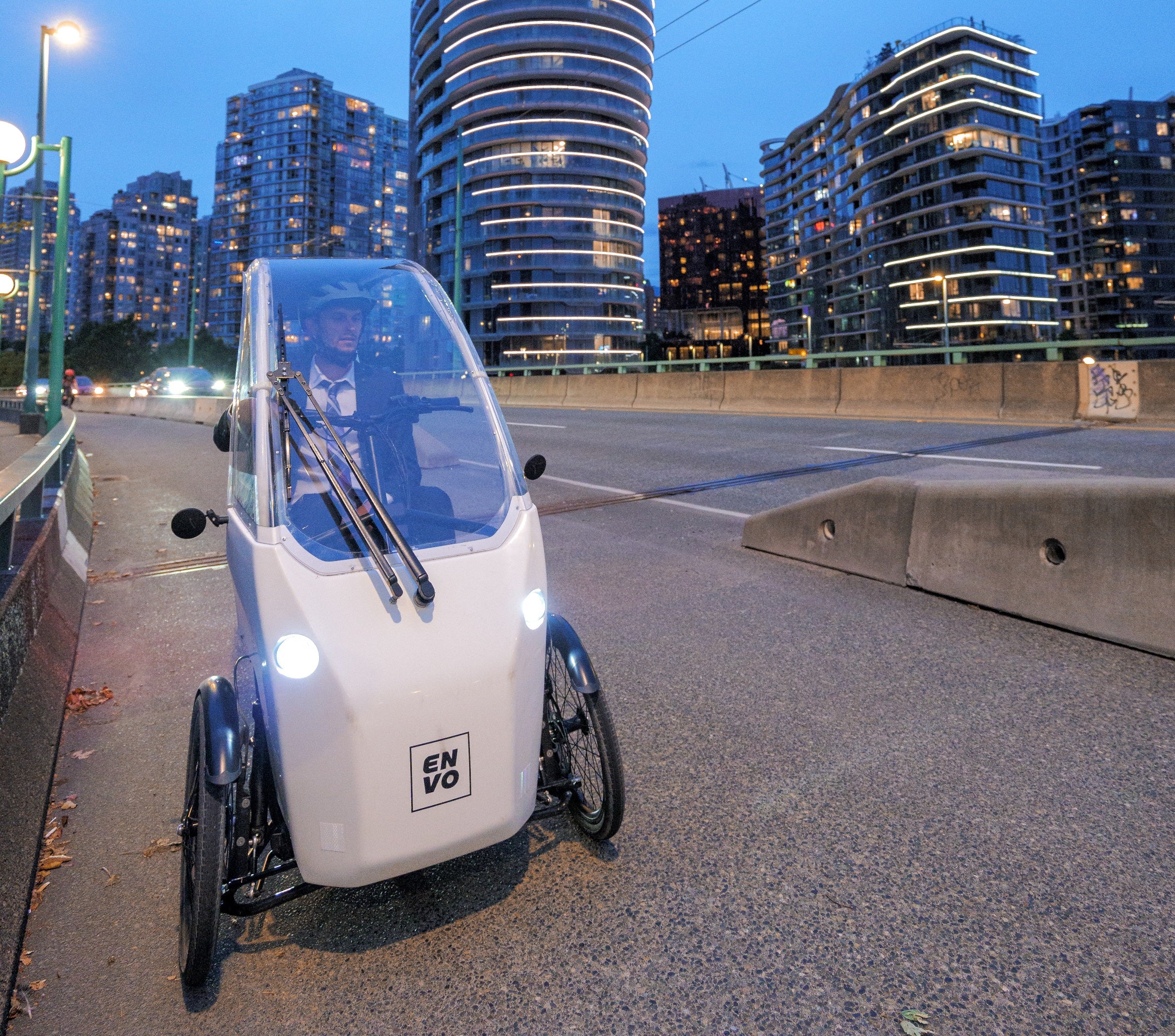
The Veemo SE is an upright-seating enclosed electric trike designed and built in Canada by ENVO Drive Systems. It stands out for its fully enclosed cabin with a rigid shell, automotive-grade lighting, integrated turn signals, and a surprisingly compact footprint for a fully enclosed vehicle.
Key specs: 500W mid-drive motor, 32 km/h top speed, ~$9,995 CAD starting price. Features include heated cabin option, windshield wiper, USB charging, and lockable doors.
What we like: The Veemo SE is the most car-like enclosed ebike on the market. The rigid enclosure provides genuine weather protection — not just a canopy or soft cover, but a hard shell with doors that lock. The upright seating position makes it accessible to riders who find recumbent positions uncomfortable. Build quality is notably high, reflecting the company's automotive engineering background.
What could be better: It is heavier than canopy-style options like the PEBL. The price point puts it in premium territory. Availability has been limited to Canada with US shipping expanding in 2026.
2. Veemo LT — Best Value Enclosed Electric Bike
The Veemo LT is Veemo's more affordable model, sharing the same core design philosophy as the SE but with a streamlined feature set. It targets commuters who want full weather protection without paying for every premium feature.
Key specs: 500W mid-drive motor, 60 km range, ~$7,495 CAD starting price, 70 kg weight.
What we like: The LT delivers the core value proposition — full enclosure, e-bike classification, pedal assist — at a more accessible price. It is lighter than the SE, which helps with handling and range efficiency.
What could be better: Reduced range compared to the SE. Fewer premium features like the heated cabin option.
3. PEBL 2.0 — Best Canopy-Style Enclosed Ebike
The PEBL (by Better Bike) is one of the original enclosed e-trikes and remains popular. The 2.0 version improved on the original with better weather sealing and an upgraded drivetrain.
Key specs: 750W hub motor, 48 km range, 32 km/h top speed, 59 kg weight, ~$8,500 USD starting price.
What we like: The PEBL is lighter than most fully enclosed options. The open sides (with optional side panels) provide ventilation in warm weather. Front cargo placement keeps the center of gravity low.
4. Hopper — Best for Cargo and Deliveries
The Hopper is a European-designed enclosed cargo trike that has gained traction in North America. Its modular cargo system sets it apart from commuter-focused models.
Key specs: 250W mid-drive motor, 60 km range, 25 km/h top speed, 65 kg weight, ~$7,000 EUR starting price. Payload capacity of 100 kg.
What we like: Outstanding cargo capacity. The modular system can be configured for deliveries, child transport, or general hauling. European build quality is solid.
What could be better: Slower top speed than competitors. The 250W motor struggles on steep hills, even with pedal assist. Availability in North America is inconsistent, and servicing can be challenging.
5. IRIS eTrike — Best Budget Enclosed Electric Bike
The IRIS eTrike offers enclosed e-trike riding at a lower price point. It takes a simpler approach to enclosure design with a bolt-on canopy system over a standard trike frame.
Key specs: 500W hub motor, 40 km range, 25 km/h top speed, 55 kg weight, ~$4,500 USD starting price.
What we like: Most affordable fully functional enclosed ebike option. Lighter weight makes it easier to handle. Simple design means fewer things to break.
What could be better: The canopy feels like an afterthought — it does not integrate as seamlessly as purpose-built enclosed designs. Wind resistance is higher due to the less aerodynamic shape.
6. ELF (Organic Transit) — Best for Eco-Conscious Riders
The ELF is a solar-assisted enclosed trike with a distinctive egg-shaped design. It pioneered the modern enclosed e-bike category and remains an interesting option despite its quirks.
Key specs: 750W motor, solar panel on roof, 48 km range, 73 kg weight, ~$9,000 USD starting price.
What we like: The solar panel adds a few km of range on sunny days. The body is made from vacuum-formed composite that is lightweight and durable. Street-legal as a bicycle in most jurisdictions.
What could be better: Company history includes bankruptcy and restarts, which raises reliability and support concerns. The open sides offer limited weather protection compared to fully enclosed models. Recumbent-style seating is not for everyone.
7. DryCycle — Best for UK and European Buyers
The DryCycle is a fully enclosed electric bicycle from the UK. It takes a unique approach with a two-wheeled design rather than a trike configuration.
Key specs: 250W motor, 32 km range, 25 km/h top speed, 30 kg weight, ~£3,995 GBP starting price.
What we like: The two-wheeled design makes it the most bicycle-like option. It is dramatically lighter than three-wheeled enclosed e-bikes. The enclosure is effective at blocking rain and wind.
What could be better: Two wheels mean you need to balance, negating one key advantage of enclosed trikes. Range is the shortest on this list. North American availability is very limited.
Among all 7 models, only the Veemo SE and Veemo LT combine a full rigid shell, mid-drive motor, and upright seating — the three features that matter most for practical year-round commuting in Canadian conditions.

Enclosed Electric Bike Comparison Table
| Model | Type | Motor | Range | Top Speed | Weight | Enclosure | Starting Price |
|---|---|---|---|---|---|---|---|
| Veemo SE | 3-wheel, upright | 500W mid-drive | 80 km / 50 mi | 32 km/h | 80 kg | Full rigid shell | ~$9,995 CAD |
| Veemo LT | 3-wheel, upright | 500W mid-drive | 60 km / 37 mi | 32 km/h | 70 kg | Full rigid shell | ~$7,495 CAD |
| PEBL 2.0 | 3-wheel, upright | 750W hub | 48 km / 30 mi | 32 km/h | 59 kg | Canopy + optional sides | ~$8,500 USD |
| Hopper | 3-wheel, upright | 250W mid-drive | 60 km / 37 mi | 25 km/h | 65 kg | Full canopy | ~$7,000 EUR |
| IRIS eTrike | 3-wheel, upright | 500W hub | 40 km / 25 mi | 25 km/h | 55 kg | Bolt-on canopy | ~$4,500 USD |
| ELF | 3-wheel, recumbent | 750W | 48 km / 30 mi | 32 km/h | 73 kg | Open-side shell | ~$9,000 USD |
| DryCycle | 2-wheel, upright | 250W | 32 km / 20 mi | 25 km/h | 30 kg | Full shell (2-wheel) | ~£3,995 GBP |
How to Choose the Right Enclosed Electric Bike
Consider Your Climate
If you live somewhere with heavy rain, snow, or cold winters, a fully enclosed model like the Veemo SE will serve you far better than a canopy-style option. The difference between a rigid shell with doors and a roof-only canopy is enormous when you are riding through a November downpour.
In milder climates, a canopy-style model like the PEBL might be sufficient. You still get sun and light rain protection without the added weight of full enclosure. For more guidance on factors to consider, check out the EbikeBC e-bike buying guide.
Think About Your Route
Hills matter. A lot. A mid-drive motor (like those in the Veemo models) handles inclines significantly better than hub motors. If your commute includes any meaningful elevation change, this distinction is worth paying attention to.
Distance matters too. If your round-trip commute is 40 km, a model with 32 km of range is going to leave you pedaling hard on the way home. Build in a buffer of at least 30% beyond your daily needs.
A velomobile rated for 60 km of range might deliver only 40 km in January with a two-year-old battery and a headwind. Always build in a 30% buffer beyond your daily distance needs.
Storage and Parking
Enclosed e-bikes are wider and longer than standard bikes. Measure your garage, bike storage area, or parking spot before buying. Most models are roughly the width of a standard wheelchair, so they fit through ADA-compliant doorways, but not through narrow bike-room doors.
Weight matters for storage too. If you need to lift the vehicle over a curb or up stairs, an 80 kg enclosed bike is a very different proposition than a 25 kg e-bike.
Legal Classification
Most enclosed electric bikes on this list are classified as e-bikes or power-assisted bicycles, meaning they can use bike lanes, don't require insurance, and don't need a driver's license. However, regulations vary by province and state. Check your local rules before purchasing. The key factors are usually motor wattage (typically 500W or 750W maximum), top assisted speed (32 km/h in Canada, 20 mph in the US for Class 1), and whether the motor only engages with pedaling.
Budget Reality
Enclosed electric bikes are not cheap. The lowest-cost option on this list starts around $4,500 USD, and a fully featured model easily exceeds $10,000. However, compared to a second car, the economics shift dramatically. No insurance, no gas, no parking fees, minimal maintenance — an enclosed ebike can pay for itself in 12 to 18 months for a daily commuter replacing car trips.
Who Should Buy an Enclosed Electric Bike?
Daily Commuters in Wet or Cold Climates
If rain or cold is the reason you drive instead of cycling, an enclosed electric bike removes that barrier. Cities like Vancouver, Seattle, Portland, Toronto, and Montreal are ideal use cases.
Older Adults Who Want to Stay Active
Three-wheeled enclosed e-bikes eliminate balance concerns. The pedal assist means you get exercise without overexertion. The enclosure means you are protected from the elements and more visible to traffic.
One-Car Households Looking to Avoid a Second Vehicle
At $8,000 to $10,000, an enclosed ebike costs a fraction of a second car. For households where the second vehicle mostly handles short trips — commuting, errands, school pickup — the math strongly favors an enclosed e-bike.
Urban Delivery and Service Workers
Models with cargo capacity like the Hopper or Veemo SE can handle delivery and light commercial use. No parking hassles, no fuel costs, and bike lane access in most cities.

Enclosed Electric Bike Maintenance: What to Expect
Maintenance on an enclosed electric bike is more involved than a standard bicycle but far simpler than a car. Here is what you should plan for:
- Tires: Expect to replace tires every 3,000 to 5,000 km. Budget $40 to $80 per tire.
- Brakes: Disc brake pads typically last 2,000 to 4,000 km depending on terrain and riding style.
- Battery: Most lithium-ion batteries retain 80% capacity after 500 to 800 charge cycles — roughly 3 to 5 years for a daily commuter.
- Drivetrain: Chain, gears, and pedal mechanism need periodic cleaning and lubrication, just like any bicycle.
- Enclosure: Canopy models may need new fabric or plastic panels over time. Rigid-shell models like the Veemo SE are more durable but may need scratch repair or weatherstrip replacement.
Annual maintenance costs typically run $200 to $500 — roughly equivalent to a single oil change and tire rotation on a car.
Our Top Picks by Category
- Best overall: Veemo SE — The most complete enclosed electric bike package with genuine all-weather protection, solid range, and thoughtful design details.
- Best value: Veemo LT — Full enclosure and mid-drive motor at a more accessible price point.
- Best budget option: IRIS eTrike — The most affordable entry into enclosed e-biking, though with compromises in enclosure quality and range.
- Best for cargo: Hopper — Unmatched payload capacity for deliveries and hauling.
- Best lightweight: DryCycle — At 30 kg, it is the lightest option by a wide margin, though the two-wheel design is not for everyone.
For Canadian commuters, the Veemo SE and Veemo LT are the only models on this list designed and built in Canada with local support, warranty service, and parts availability. You can also browse the EbikeBC catalog for additional e-bike options suited to Canadian riding conditions.
Frequently Asked Questions
Ready to Ride Smarter?
Explore the Veemo SE and Veemo LT — designed and built in Canada for all-season commuting with full weather protection and e-bike classification.
Explore Veemo SE View Veemo LT