
Best Podbike Alternative in 2026: What to Buy After Podbike's Bankruptcy
If you are one of the 4,000+ customers who pre-ordered a Podbike Frikar and are now wondering what happened to your order — and your money — you are not alone. Podbike filed for bankruptcy in May 2025, leaving thousands of backers without the enclosed velomobile they were promised. The good news? The Veemo SE and Veemo LT are actually shipping today.
The company's assets were acquired by Phase Energy, which has rebranded the project as TwoZero, but the future remains uncertain for anyone who was counting on a Frikar delivery. The enclosed electric velomobile category did not die with Podbike. If you are searching for a Podbike alternative that is actually shipping, actually available, and actually backed by a real company, this guide covers exactly what happened, how Veemo compares spec-for-spec, and why former Frikar backers are making the switch.

What Happened to Podbike? The Full Timeline
The Promise (2016–2022)
Podbike, a Norwegian startup founded by Per Hassel Sorensen, launched with an ambitious vision: a four-wheeled, fully enclosed, pedal-electric velomobile called the Frikar. The concept was compelling — a weather-protected vehicle that combined the health benefits of cycling with the comfort of a car, powered by pedal-assist electric drive.
The Frikar attracted massive attention. Crowdfunding campaigns and pre-orders poured in from around the world. By 2022, over 4,000 customers had placed deposits, collectively representing millions of dollars in pre-order revenue. The promise was always "shipping soon" — next quarter, next year, after the next prototype revision.
The Delays (2022–2024)
Production delays became a defining feature of the Podbike story. The Frikar went through multiple redesigns. Manufacturing partnerships were announced and then dissolved. Delivery dates were pushed back repeatedly. Communication with backers became increasingly infrequent and vague.
Red flags included:
- Repeated prototype revisions that suggested fundamental engineering challenges
- Shifting manufacturing plans — from Norway to Asia and back
- Pre-order money being used for R&D rather than production tooling
- Key team departures
- Lack of independent reviews or test rides of production-intent vehicles
The Bankruptcy (May 2025)
In May 2025, Podbike AS filed for bankruptcy in Norway. The announcement confirmed what many backers had feared: the company had run out of money before delivering a single production vehicle to a paying customer. Pre-order deposits — in many cases $500 to $2,000+ per customer — were effectively lost.
The bankruptcy estate was acquired by Phase Energy, which announced plans to continue development under the new brand name TwoZero. However, as of early 2026, TwoZero has not delivered production vehicles, and former Podbike customers have no guaranteed timeline or refund path.
Where Things Stand Now (2026)
The TwoZero project (formerly Podbike/Frikar) remains in development. Former backers face an uncomfortable reality:
- Pre-order deposits from Podbike are likely unrecoverable through the bankruptcy process
- TwoZero has not committed to honoring Podbike pre-orders at original pricing
- No confirmed production timeline has been published
- The design may change significantly under new ownership
For anyone who wanted an enclosed velomobile for practical daily transportation — not as a speculative investment in a startup — it is time to look at alternatives that are actually available today.
Why Veemo Is the Natural Podbike Alternative
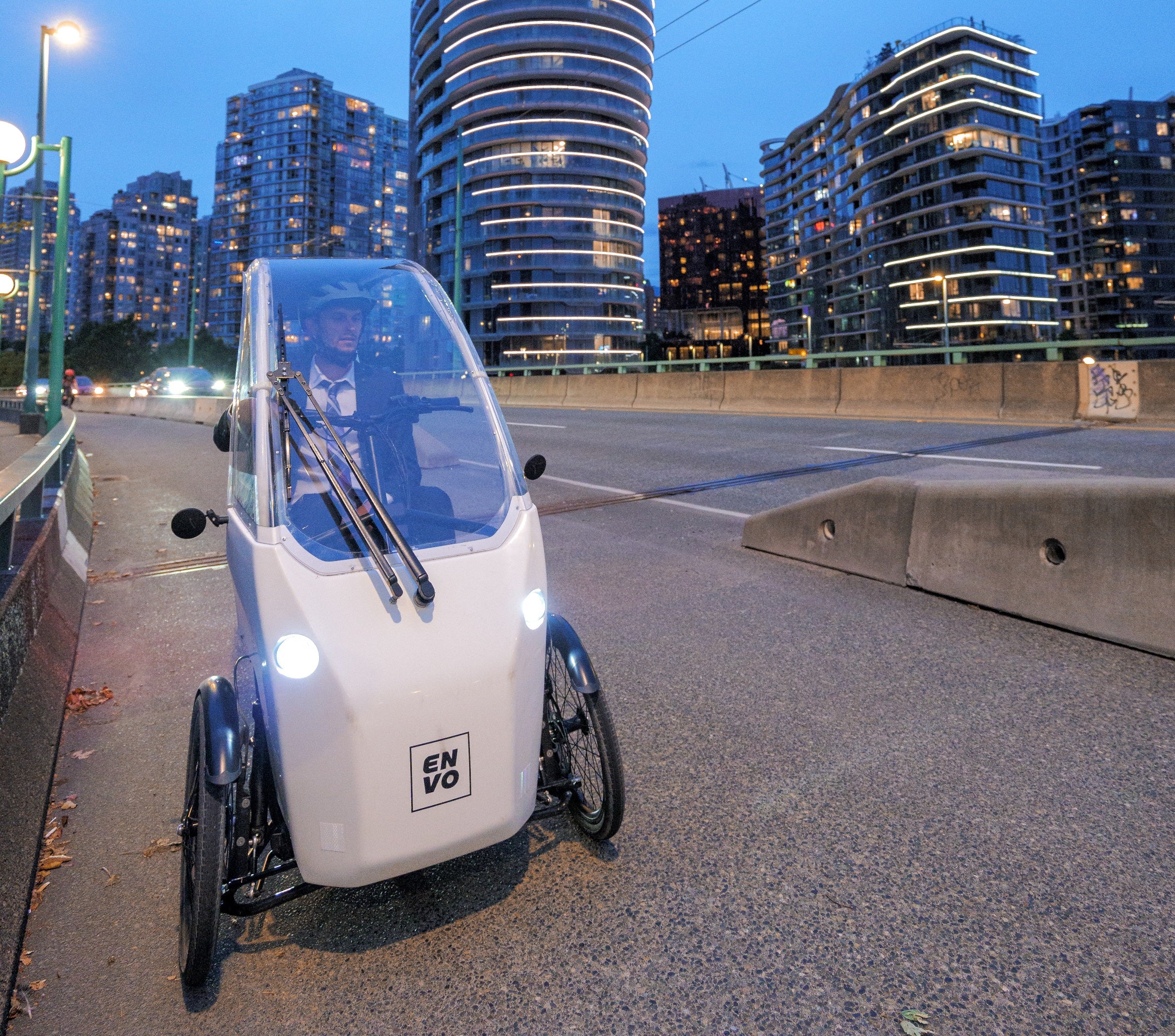
The Veemo SE delivers on the same core promise that attracted people to the Podbike Frikar: a fully enclosed, pedal-assist electric vehicle for daily commuting that protects you from weather, provides exercise, and classifies as an e-bike. Built by ENVO Drive Systems in Vancouver, Veemo is a real company shipping real products.
Similarities to What Podbike Promised
- Full weather enclosure — Protection from rain, snow, wind, and cold
- Pedal-assist electric drive — Combine exercise with electric power
- E-bike classification — No license, registration, or insurance required in most jurisdictions
- Designed for daily commuting — Not a toy or weekend novelty, but practical daily transportation
- Compact urban footprint — Much smaller than a car, fits in bike infrastructure
Where Veemo Improves on Podbike's Concept
- Three wheels vs. four — Veemo uses a three-wheel (tadpole trike) layout. This provides excellent stability while being narrower than Podbike's four-wheel design, making it better suited to bike lanes and tight urban spaces.
- Actually available — This is the most important difference. You can order a Veemo and receive it. Podbike/TwoZero remains a concept.
- Canadian company with local support — Veemo is based in Canada with local customer service, parts, and warranty support. No dealing with overseas shipping, customs, or foreign-language support channels.
- Two models for different needs — The Veemo SE for commuters and the Veemo LT for lighter-duty riders, versus Podbike's single-model approach.
- Proven design — Veemo's design has been refined through real-world testing and customer feedback, not just prototype iterations in a lab.
A beautiful render, an exciting prototype, and a charismatic founder are not a product. Veemo is shipping vehicles and has real customers using them daily. Podbike/TwoZero remains a concept in development.
Veemo vs. Podbike Frikar: Spec-for-Spec Comparison
| Specification | Podbike Frikar (Planned) | Veemo SE | Veemo LT |
|---|---|---|---|
| Wheels | 4 | 3 | 3 |
| Enclosure | Full (planned) | Full | Full |
| Drive Type | Pedal-assist electric | Pedal-assist electric | Pedal-assist electric |
| E-Bike Classification | Intended | Yes | Yes |
| License Required | No (planned) | No | No |
| Weather Protection | Full (planned) | Full | Full |
| Range | 60 km (planned) | 80+ km | 60+ km |
| Motor | 250W (planned) | 500W mid-drive | 500W mid-drive |
| Country of Design | Norway | Canada | Canada |
| Shipping Status | Never shipped (bankrupt) | Available now | Available now |
| Company Status | Bankrupt (acquired as TwoZero) | Active, shipping | Active, shipping |
| North American Support | None | Yes (Canadian HQ) | Yes (Canadian HQ) |
| Bike-Lane Compatible | Uncertain (4-wheel width) | Yes | Yes |
Note: Podbike Frikar specifications are based on the last published planned specs before bankruptcy. The vehicle was never produced, so these specs were never validated in production.
Lessons from the Podbike Bankruptcy: What to Look For
The Podbike failure offers valuable lessons for anyone shopping in the enclosed velomobile category. Here is what to look for — and what red flags to avoid.
Is the Company Actually Shipping Products?
This is the single most important question. Before putting money down, ask:
- Can I see verified customer reviews (not testimonials on the company's own website)?
- Can I find independent media reviews with hands-on testing?
- Is there a physical showroom or demo opportunity?
- What is the lead time between order and delivery?
Veemo passes this test. The company is shipping vehicles and has real customers using them daily. You can also check what real-world owners are saying through the Veemo FAQ and community forums.
Is the Company Financially Stable?
Podbike burned through pre-order revenue funding R&D — a classic startup death spiral. Look for companies that have revenue from actual product sales, are transparent about their business model, have been operating for multiple years, and are not dependent on a single future fundraising round to survive.
Beware of companies that fund R&D with pre-order deposits, repeatedly push delivery dates, and lack independent reviews of production vehicles. These were all warning signs with Podbike — and they cost thousands of customers their deposits.
Is There Local Support?
If something breaks on your enclosed velomobile, you need parts and service. Podbike backers in North America would have faced shipping parts from Norway — assuming the company was still operational. A Canadian company like Veemo, backed by ENVO Drive Systems, offers local support, local parts availability, and an understanding of Canadian road conditions and regulations. You can explore e-bike support options broadly at EbikeBC.
Does the Design Actually Work for Bike Lanes?
Podbike's four-wheel design was wider than most bike lanes, raising questions about where it could legally and practically be ridden. Veemo's three-wheel tadpole configuration is narrower, fitting comfortably in standard bike lanes — which is where you want to be for safety and convenience in Canadian cities.
Other Podbike Alternatives Considered
TwoZero (Formerly Podbike)
Phase Energy acquired Podbike's assets and is developing the TwoZero. If you are willing to wait and accept the risk of another startup, this is the closest to the original Frikar concept. However, given Podbike's history, many backers are understandably cautious about trusting the same project under a new name.
Traditional Velomobiles
Companies like Sinner, ICE, and others produce recumbent velomobiles — enclosed, human-powered trikes with aerodynamic fairings. These are excellent vehicles but differ from the Podbike/Veemo concept in important ways: they are typically fully human-powered (no electric assist), designed for speed-focused cycling enthusiasts, and extremely expensive ($8,000–$15,000+). They are not practical commuter vehicles for most people.
DIY Enclosures on E-Trikes
Some former Podbike backers have attempted to build their own enclosed e-trikes by adding fairings or canopies to existing electric trikes. Results vary widely. DIY enclosures typically lack the aerodynamic design, structural integrity, and weather sealing of a purpose-built vehicle. They can also create safety issues with visibility and stability.
Why Veemo Stands Apart
Among all these alternatives, Veemo occupies the unique position that Podbike originally targeted: a purpose-built, fully enclosed, pedal-assist electric vehicle designed for practical daily commuting, classified as an e-bike, and actually available for purchase. No other product on the market in 2026 matches this combination. You can compare your options on the EbikeBC urban commuter collection page or consult the detailed EbikeBC buying guide.
As of 2026, Veemo is the only purpose-built, fully enclosed, pedal-assist electric vehicle that is e-bike classified, designed for daily commuting, and actually shipping in North America.
For Former Podbike Backers: Making the Transition
If you put money down on a Podbike Frikar, the transition to Veemo is straightforward. Here is what former backers should know.
Your Use Case Is the Same
You wanted an enclosed velomobile for commuting. That has not changed. The Veemo SE serves exactly the same purpose — weather-protected, pedal-assist, e-bike-classified daily transportation.
The Core Experience Is Similar
Pedaling with electric assist inside an enclosed cabin. Arriving dry in the rain. Riding in regular clothes. Getting exercise on your commute. These are the experiences that attracted you to Podbike, and they are exactly what Veemo delivers.
What Is Different (And Often Better)
- Three wheels instead of four — Narrower profile, better bike lane compatibility, simpler drivetrain
- Canadian design and support — If you are in North America, this is a significant practical advantage
- Lighter model available — The Veemo LT is a lighter option for riders who want a more compact enclosed e-bike at a lower price point
- Proven reliability — Real customers, real miles, real feedback loop — not theoretical specs from a prototype
- 500W mid-drive vs. 250W — The Veemo's more powerful motor handles hills significantly better than the planned Frikar specs

The Broader Market: Why Enclosed E-Bikes Are the Future
Podbike's bankruptcy does not mean the enclosed velomobile concept is flawed. It means that one particular company failed to execute. The underlying demand is stronger than ever:
- Climate concerns are pushing more people toward zero-emission transportation
- Urban congestion is making cars increasingly impractical for short commutes
- Health awareness is driving interest in active transportation
- Cost of living is making the $10,000+ annual cost of car ownership harder to justify for short-distance commuting
- Cycling infrastructure is expanding rapidly in Canadian cities, making bike-classified vehicles more practical than ever
Veemo is positioned at the intersection of all these trends — a practical, affordable, weather-protected alternative to both cars and open bikes. Podbike's failure was a company execution problem, not a concept problem.
How to Order a Veemo
If you are ready to move on from the Podbike disappointment, here is how to get started with Veemo:
- Choose your model — The Veemo SE for maximum range and features, or the Veemo LT for a lighter, more affordable option.
- Visit the product page — Review current specifications, pricing, and availability at veemo.ca.
- Check the FAQ — The Veemo FAQ answers questions about local regulations, shipping, and specifications.
- Reach out with questions — Veemo's team can answer questions about compatibility with your commute, local regulations, and delivery timelines.
- Place your order — Unlike Podbike, you are ordering from a company that is actively shipping products.
Frequently Asked Questions
After Years of Delays, Ride Something Real
After years of delays and a bankruptcy, you deserve a vehicle that actually exists. The Veemo SE is shipping now — built in Canada, backed by ENVO Drive Systems.
Explore Veemo SE View Veemo LT